
How I got a top 10% VO2 Max with minimal effort
The 80/20 rule of improving VO2 max. How just 3 hours per week improved my VO2 max by over 10 points in under 1 year.

VO2 Max. The maximum amount of oxygen your body can use during exercise, and a really big indicator of heart health and overall longevity.
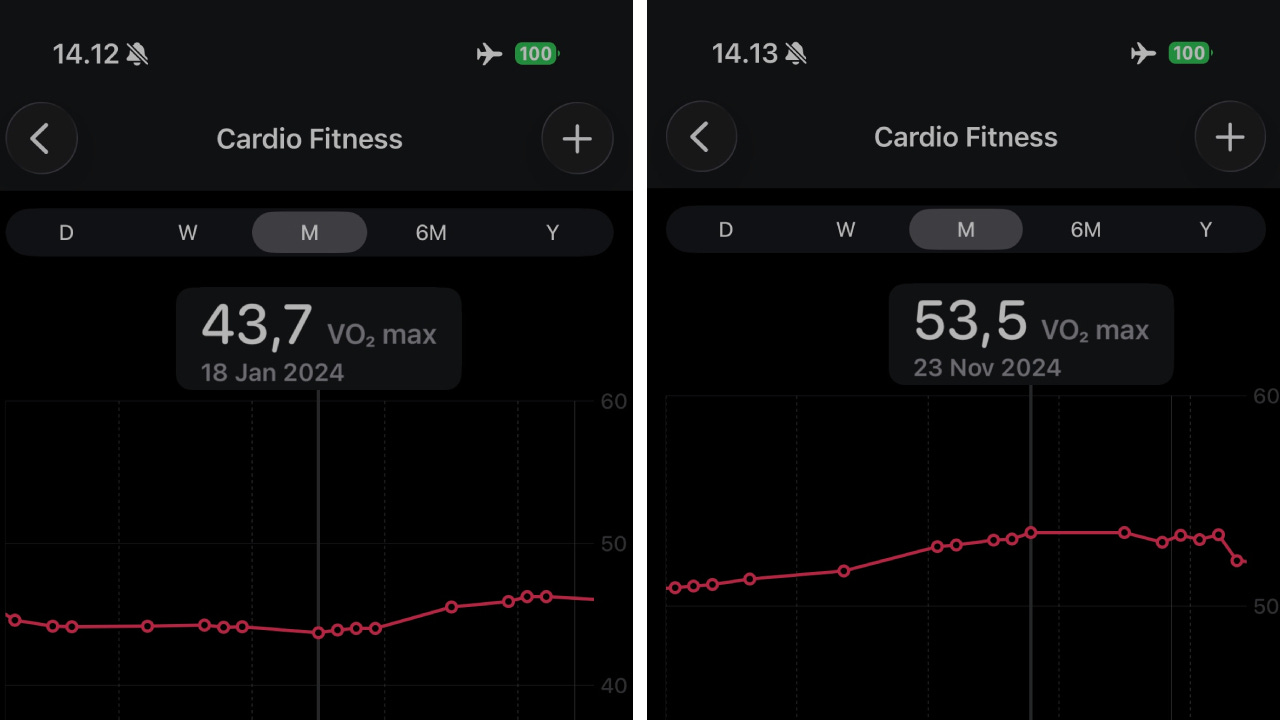
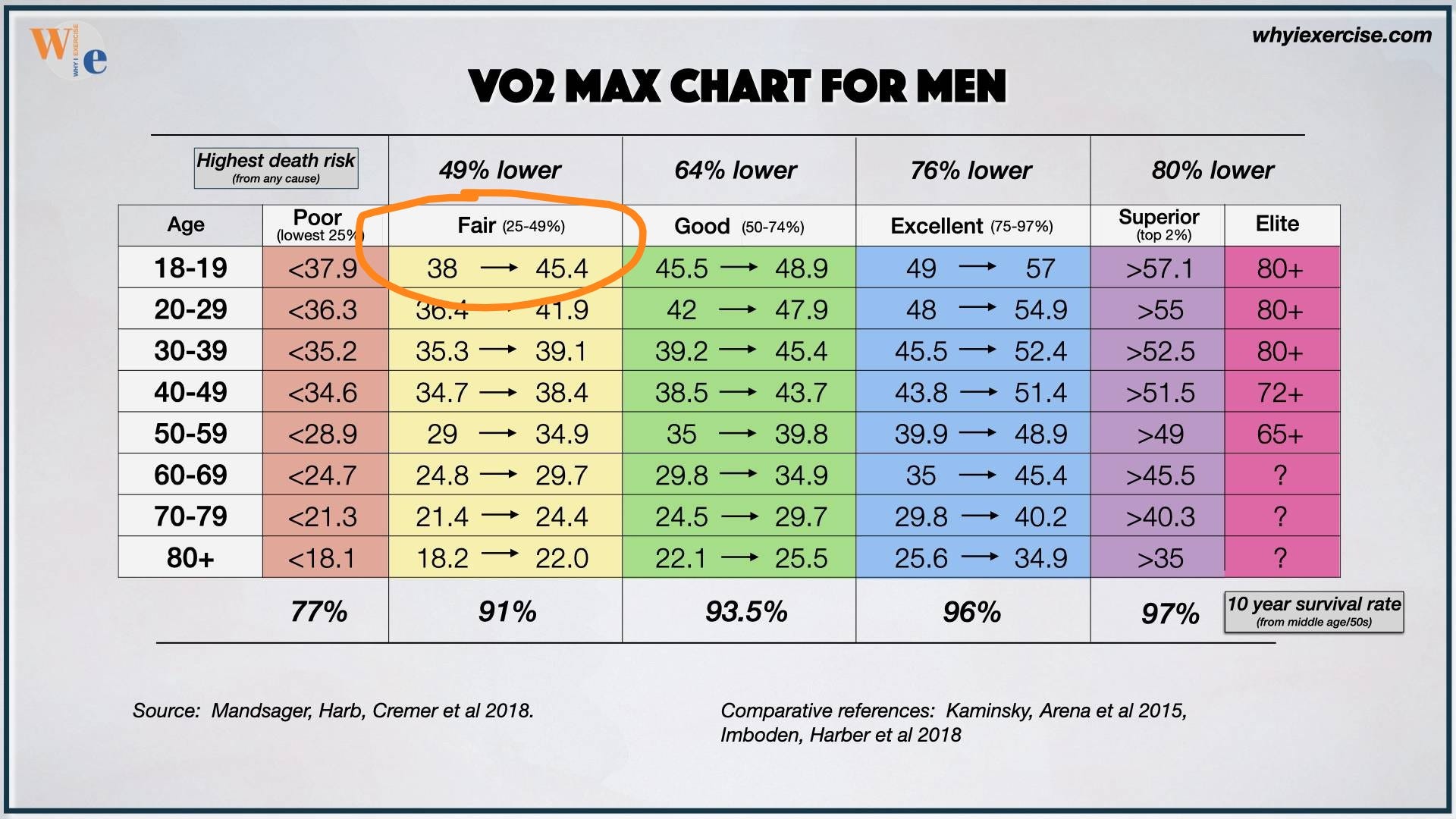
So you can understand how it was quite a bummer when I first unboxed my apple watch a couple years ago and found out that I had a pretty bad VO2 max (bottom 50%).
When I first saw that 43 VO2 max in my apple health app I decided I needed to change that. I couldn’t walk around with a shitty VO2 max and potentially all the negative consequences that come from it.
But there was just one problem. I didn’t really like doing cardio (and who really does tbh?).
So I set out on a mission to improve my VO2 max as much as possible with the least amount of effort. The 80/20 rule of cardio if you wanna call it that. So I started watching podcasts, reading studies and just tried consuming as much information on this topic as possible, and this is what I came up with:
Okay just before I show you the actual routine I just wanna go over some studies looking at VO2 max and how important it is for longevity so you actually get serious about trying to improve it lol.
1. Association of Cardiorespiratory Fitness With Long-term Mortality Among Adults Undergoing Exercise Treadmill Testing

This study looked at over 120,000 people and found a strong inverse correlation between high VO2 max and all-cause mortality, meaning higher VO2 max = longer life.
2. Cardiorespiratory Fitness as a Quantitative Predictor of All-Cause Mortality and Cardiovascular Events in Healthy Men and Women

This meta-analysis looked at over 30 studies with over 100,000 participants and once again found a strong correlation between a high VO2 max and lower rates of cardiovascular disease, coronary heart disease and all cause mortality.
The study found that for every 1 MET increase (3.5ml/kg/min) you reduce your mortality risk by 13-15%. So for me that’s nearly 3 MET’s I increased my VO2 max by which is a about 40% decrease in relative mortality risk. Obviously my mortality risk is already super low since I’m 20 years old but you get the point. The older you get, the more it’s gonna help.
Okay enough studies and stuff, let’s look at the routine I used to increase my VO2 max by 10 points in about a year, taking me from the “fair” category to the middle of the “excellent” category.
Part 1: Aerobic base
If you look at your entire cardio fitness as a pyramid, what you want to spend the most amount of time building is the base, or the aerobic base. The wider the base you build, the higher the peak you can get (VO2 max).
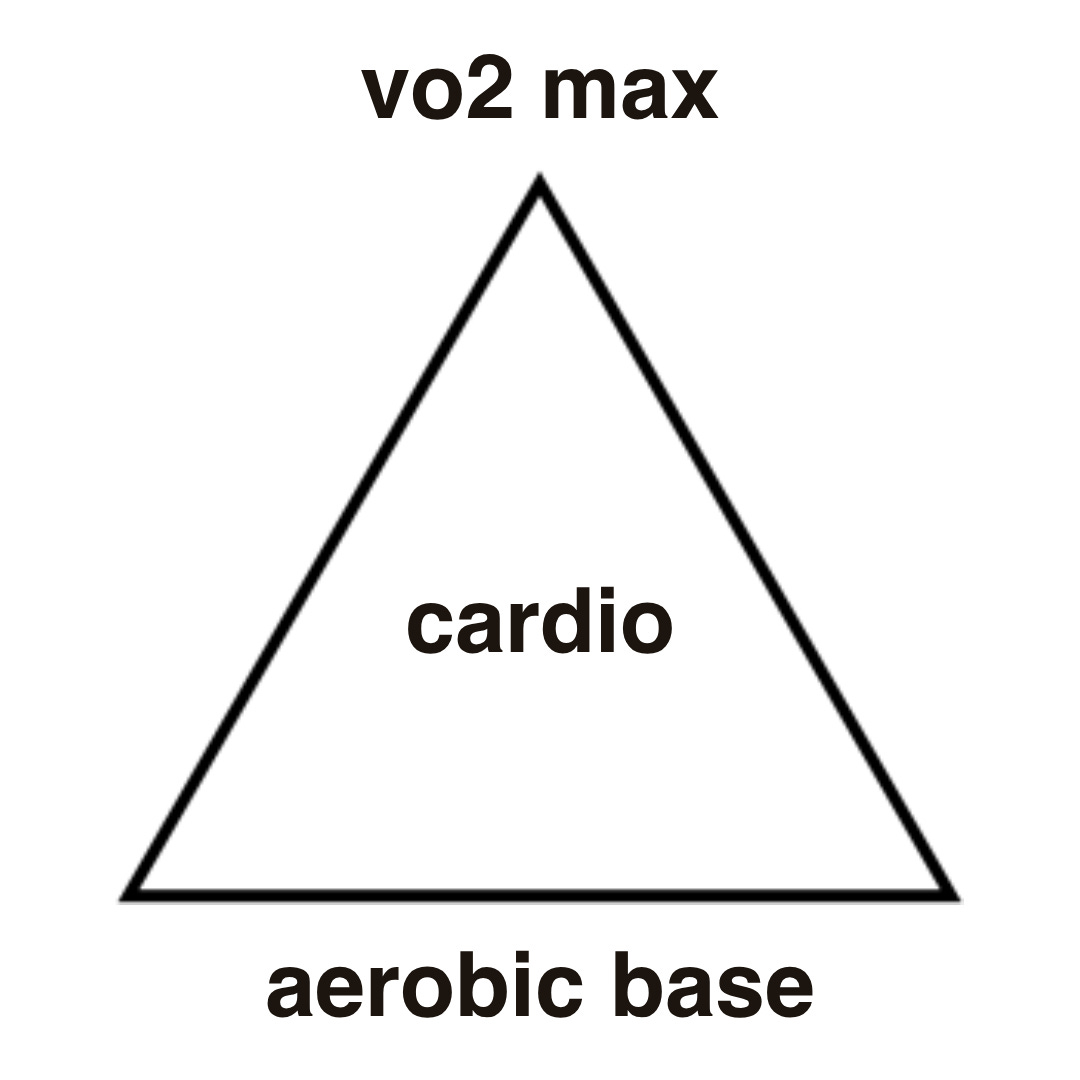
Your aerobic base is your body’s ability to use oxygen for sustained efforts, so longer distances or periods of time. It improves your heart strength, improves your fat burning abilities, recovery abilities and is great before adding harder, more intense training to actually increase your VO2 max.
Think of it like this thing that doesn’t directly improve your VO2 max but allows you to improve it with other exercise. Like I said, the wider the base, the higher the peak you can build.
If you just skip this step and go straight into actual VO2 max training you will miss out on the improved efficiency you build from this along with the improved mitochondrial function, fat burning and recovery.
Another analogy you can use is a car one (lol). A ferrari goes really fast, but has pretty bad gas mileage. A toyota prius is the opposite. Great gas mileage but really slow. With your cardio you can improve both. Your aerobic base is your gas mileage, how efficient you are, and your peak (VO2 max), how fast you go.
And it’s weird cause the better gas mileage you get, the faster you can go.
So how do you improve your aerobic base?
There’s a lot of different workouts out there for improving your aerobic base but in the end it comes down to doing steady state cardio for an extended period of time. But remember, I wanted to get the most bang for my buck with this routine so this is what I came up with:
Zone 2.
Yes, zone 2. I know you’ve probably heard everyone and their grandmother talk about zone 2 training, but it’s simply because it’s the best. The best at improving mitochondrial function, fat burning abilities, endurance, etc. all while improving your recovery abilities and being low intensity so it doesn’t really interfere with your recovery from other types of training.
So what actually is zone 2?
Zone 2 is a specific low intensity training zone where you improve your utilization of fat as energy and improve mitochondrial function. Some say it’s a specific heart rate zone, normally between 60-70% of your max heart rate and other people define it as a zone where you keep your lactate below a certain threshold (lactate is the thing that makes your muscles “burn”).
Most people don’t have a lactate meter so it’s easiest to go off the heart rate zone or using the talk test. The talk test is basically whether or not you can carry out a conversation quite comfortable while doing the training. If you can, that’s a good indication that you’re in zone 2.
If you have a heart rate monitor you can also use that and try to stay within 60-70% of your max heart rate. To find that zone you need to find your max heart rate which you do by using a website or using the basic formula of 220 minus your age.
Example:
I am 20 so I take 220-20=200.
200 * 0.6 = 120
200 * 0.7 = 140
Therefore my zone 2 is estimated to be somewhere around 120-140bpm.
So how much zone 2 should you do?
All the big names in the space says you need to get about 150-200 minutes of zone 2 per week, which is quite a lot if you also wanna have time for strength training and not make exercise your full time job.
So I aimed for just 120 minutes or 2 hours of dedicated zone 2 training per week, and that got me pretty good results.
The thing about zone 2 is that it’s so low intensity that you might just get some accidental extra minutes throughout the week by just living your life.
However, zone 2 training is most effective in sessions of at least 30 minutes, so you have time to actually get into the zone and start burning fat and getting all the benefits. You can’t just do 15 sessions of 10 minutes throughout the week (i don’t know why you would do that anyways).
So I decided on 2 sessions throughout the week of 1 hour each, and sometimes I did 3 sessions instead, but then for only 45 minutes.
And don’t worry, I know you might be thinking “1 hour of cardio, who does this guy think i am!?” And yes, it sounds like a lot to do 1 hour of cardio in a session (at least it did for me), but zone 2 is so low intensity that it’s not really that challenging, don’t worry.
Okay, now you know the duration, but what should you actually do? Running, cycling, swimming, walking???
What I found worked best for me was the stationary bike. This really goes against what I normally preach with working out outside, getting sunlight and all that stuff, but for zone 2 I make an exception for a couple reasons:
It makes it a lot easier to stay in zone 2
You can watch podcasts and make time go by quicker
It’s low impact on the joints
So first up, it makes it easier to stay in zone 2. Let’s say I was out on a road bike. I would have to stop for red lights, getting me below my zone 2 and then I would come to a hill that I would have to go up getting me above my zone 2 etc.
It’s obviously possible if you find a good route and just really watch your heart rate and breathing, but it’s just much easier to “get in the zone” on a stationary bike in my opinion.
You can try out whatever kind of exercise you prefer, I am just telling you what worked best for me. But another reason why I started out doing the stationary bike is that you can watch podcasts or educational videos while you do it, which can make the time go by faster, which helps you actually get the full 45-60 minutes done.
I also tried out jogging because I would’ve preferred to do the exercise outside like I said but I was quickly humbled and found out you have to be in pretty good shape to jog in zone 2 which I wasn’t when I started out.
You can test it out for yourself and find whatever kinda exercise works best for you. Swimming is another great option that I’m getting into as it’s also super low impact on the joints compared to running/jogging and therefore isn’t as stressful to the body.
Stairmaster is another great option, like you get the point. In the end it’s just about picking one that you will actually stick to.
Another thing you want to do for your aerobic base is literally just walking. Super easy.
Walking is such an S tier activity and something you should be doing every single day. Super low intensity and low impact, so it doesn’t stress the body and increase cortisol unnecessarily. A lot of people work out way to much and are constantly stressed out from all the exercise they do which messes up their recovery and their gains, whether that’s cardio, strength or size.
Just start walking 10k steps per day. Easy. It will help you burn fat, increase metabolism and is just great for general health. It takes about 60-90 minutes to walk 10k steps so try to fit it in throughout the day.
I normally do 20 minutes in the morning for getting morning sunlight and setting my circadian rhythm and then try to fit in a couple walks throughout the day.
Btw, you don’t need to hit your 10k on a day where you’re doing zone 2.
Part 2: The peak
Now you have the base of the pyramid down, but what about the peak? Actually the peak is super simple and doesn’t take a lot of time. I spent 20-30 minutes per week on it.

What I did was high intensity interval training (HIIT), but more specifically the norwegian 4x4 method. This was a specific HIIT workout developed by some norwegian researchers for improving VO2 max that worked really well.
Its called the 4x4 because you do 4 minutes of maximum sustained effort followed by 4 minutes of rest and then repeat that for a total of 4 times.
It takes about 30 minutes including warm up, and I did this once a week and got great improvements in my VO2 max.
Don’t be fooled by the short amount of time it takes to complete this and think that it’s some easy workout. It’s not. You literally feel like dying if you do it right and it takes a lot of recovery ability so it’s important to not overdo it.
I wouldn’t do more than two sessions per week, especially if you also do other kind of exercise.
You might be thinking: “how am I suppose to do my max effort for 4 minutes??”
It’s not an all out effort for 4 minutes. You pick a pace you can sustain for no more than 4 minutes so by the time you’re at 3 minutes and 50 seconds you need to push yourself to 110% to get to 4 minutes and finish like you couldn’t have done another second even if your life depended on it.
So you basically pick a pace you can sustain for 4 minutes. It’s gonna take a couple workouts to get right and it’s fine if your sets are a little over or under the 4 minute mark. The important thing is just that you get to your max heart rate before the set is over.
I did this workout with sprint intervals, but once again you can pick whatever exercise you enjoy. I just found sprinting to be the easiest and most enjoyable, as you can do it outside, get sunlight, fresh air etc.
That’s basically it. I did this pretty consistently for about a year and saw my VO2 max increase by over 10 points, which is pretty great if you ask me, especially considering I didn’t make my entire life about cardio.
All this took only about 3 hours per week, if you don’t count the walking which I would have done anyways.
Thanks for reading and godspeed.
— Kasper Veritas